
Do you really know how your team feels?
Measure organizational climate, your employees' NPS, and your company's cultural profile in real time. Identify dissatisfaction hotspots before they turn into unwanted turnover.
4
measurement modules
Continuous
engagement monitoring
Anonymous
honesty guarantee
342 responses · 91% participation
72
Excellent
78%
Promoters
15%
Passives
7%
Detractors
The cost of organizational silence
67%
of LATAM employees are disengaged, according to Gallup 2024. Most of those companies don't measure it.
Disengagement costs between 1 and 2 annual salaries per employee in lost productivity. Measuring it isn't a cost — it's the lowest-cost, highest-return investment in HR.
The quiet quitting
The employee stopped engaging months before resigning. Without continuous measurement, HR didn't catch the signals and turnover took everyone by surprise.
Climate managed by perception
Decisions are based on what the manager thinks the team feels, not what the team actually feels. Without data, climate management is pure intuition.
Annual surveys that arrive too late
One survey a year isn't a pulse — it's an old photo. The problem has already multiplied by the time the results land on HR's desk.
Declared culture vs. real culture
The values are on the wall, but nobody knows if employees identify with them. Cultural misalignment is the leading cause of turnover that no one measures.
Climate Survey
Real data on how your team experiences the day-to-day.
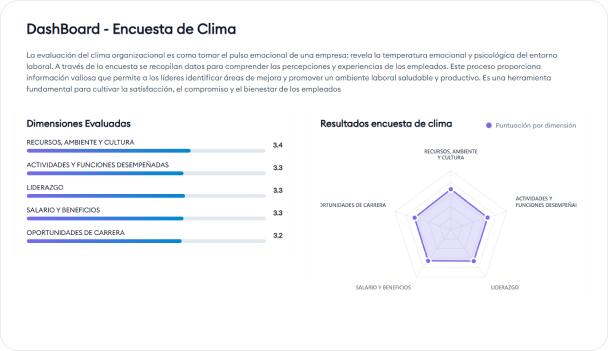
MyDNA's climate survey captures every employee's perception of the dimensions that most impact engagement. Results are presented in bar and radar charts to make area-by-area diagnosis easy.
- 📈Results by dimension: leadership, communication, recognition, wellbeing, development, and balance
- 🔍Bar and radar chart visualization to compare dimensions
- 🔒Anonymous responses to ensure honesty and high participation rates
- 📅Configurable frequency: monthly, quarterly, or short pulses between cycles
- 📄Export results for executive presentations and action plans
Net Promoter Score
One question. One number. A complete picture of engagement.
The eNPS (Employee Net Promoter Score) measures in a single question whether your employees would recommend your company as a place to work. It's the world's most widely used engagement indicator for its simplicity and immediate interpretation.
Promoters
9–10
Company ambassadors
Passives
7–8
Satisfied but not committed
Detractors
0–6
At risk of leaving
- 🎯NPS segmentation by area, level, or business unit
- 📈Historical score trend to measure the impact of actions taken
- ⚡Results available in real time after each survey closes
Culture & Cultural Match
Discover your company's real culture. And who fits it.
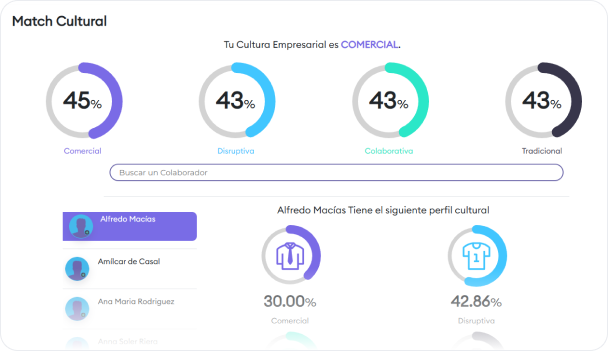
The company's cultural profile is generated from a questionnaire completed by HR in 4 stages. The result is your organization's cultural DNA — and the foundation for each employee's individual match.
Company cultural profile
Results-oriented, competitive, and market-focused
Innovative, agile, and willing to challenge the status quo
Built on teamwork, consensus, and relationships
Stable, hierarchical, and process-oriented
4-stage questionnaire
Individual Cultural Match
Compares the company's cultural profile with each employee's individual profile. Identifies who is most aligned and who may feel cultural tension — a key early predictor of turnover.
What is Cultural Match used for?
- Detect employees at risk of cultural misalignment
- Prioritize cultural integration actions
- Support onboarding and internal mobility decisions
- Measure the impact of organizational culture initiatives
How to use each cultural profile
Knowing the profile isn't enough — what matters is what you do with it.
Each cultural profile implies specific strengths and risks for talent attraction, retention, and development. These are the key levers by culture type.
- Attracts competitive, results-driven profiles
- Motivate with targets, bonuses, and public recognition
- Watch the balance: high pressure can drive turnover
- Best fit for: sales, product, growth, business roles
- Attracts innovators with high tolerance for uncertainty
- Foster autonomy, fast learning, and experimentation
- Risk: traditional profiles will feel cultural tension
- Best fit for: tech, product, innovation, startups
- Attracts profiles that value teamwork and consensus
- High retention — low voluntary turnover
- Watch decision-making speed
- Best fit for: HR, operations, customer service
- Attracts profiles that value stability and clear processes
- High resistance to change — manage transformations carefully
- Strong retention in technical and operational roles
- Best fit for: finance, legal, critical operations
The impact of measuring
What changes when you stop guessing.
4×
higher retention at companies that measure climate continuously
67%
of LATAM employees disengaged (Gallup 2024)
-40%
turnover reduction with data-driven climate actions
91%
average participation rate with short anonymous surveys
Designed for
Everyone responsible for the employee experience.
CHRO & HR Leadership
- Consolidated climate view across the entire organization
- Data to justify culture initiatives to the business
- Engagement KPIs for executive and board reports
- Climate comparison across areas and business units
HR Business Partner
- Climate diagnosis by area under their responsibility
- Early disengagement alerts before resignation
- Data foundation for conversations with area leaders
- Cultural match to support internal mobility decisions
Managers & Leaders
- Visibility of their own team's NPS and climate
- Identify critical dimensions to work on with the team
- Tool for feedback and improvement conversations
- Measure the impact of their actions on team climate
CEO & Board
- Single organizational engagement indicator (eNPS)
- Climate-turnover correlation for strategic decisions
- Climate benchmark vs. sector competitors
- Cultural fit visibility as a competitive factor
Frequently asked questions
What people ask before running their first survey.
How often is the climate survey run?
⌄
The frequency is configurable by HR: monthly, quarterly, or semi-annually. Short pulses can also be activated between main cycles to measure specific changes without overwhelming employees.
What dimensions does the climate survey measure?
⌄
It measures key dimensions such as direct leadership, internal communication, recognition, work-life balance, wellbeing, and professional development. Results are presented by dimension with bar and radar charts.
What is Cultural Match and what is it used for?
⌄
Cultural Match compares the company's cultural profile with each employee's individual profile. It identifies who is most aligned and who may feel cultural tension, helping to prevent turnover from cultural misalignment.
Are survey responses anonymous?
⌄
Yes. Individual responses are anonymous. HR sees consolidated results by dimension and area, without being able to identify any specific employee's responses.
Can the NPS be viewed by area or team?
⌄
Yes. The eNPS can be segmented by area, level, or business unit, making it possible to identify where dissatisfaction is concentrated and prioritize improvement actions.
How many dimensions does MyDNA's climate survey cover?
⌄
The survey covers the key dimensions of employee engagement: direct leadership, internal communication, recognition, work-life balance, wellbeing, and professional development. Results are shown per dimension in bar and radar charts to simplify diagnosis by area.
How often can I run a climate survey or a pulse check?
⌄
Frequency is fully configurable: monthly, quarterly, or semi-annual for main cycles. Between cycles, you can activate short pulses (2-3 questions) to measure the impact of a specific initiative without survey fatigue.
How does HR use the cultural profile for hiring or development decisions?
⌄
Once the company's cultural profile is generated (Commercial, Disruptive, Collaborative, or Traditional), HR can cross it with each candidate's or employee's individual profile. This helps identify high cultural match before hiring and detect misalignment risk in current employees — allowing action before they resign.
Have more questions? Let's talk →
Free demo
See in 30 minutes how to measure your company's climate with MyDNA.
We'll show you how to configure your first climate survey, activate the NPS, and generate your company's cultural profile — with real data and results in minutes.
Plataforma en detalle
Clima y cultura en detalle